
Zodiac Compatibility, Beyond Sun Signs: The Complete Guide (Moon, Venus, Mars & Synastry)
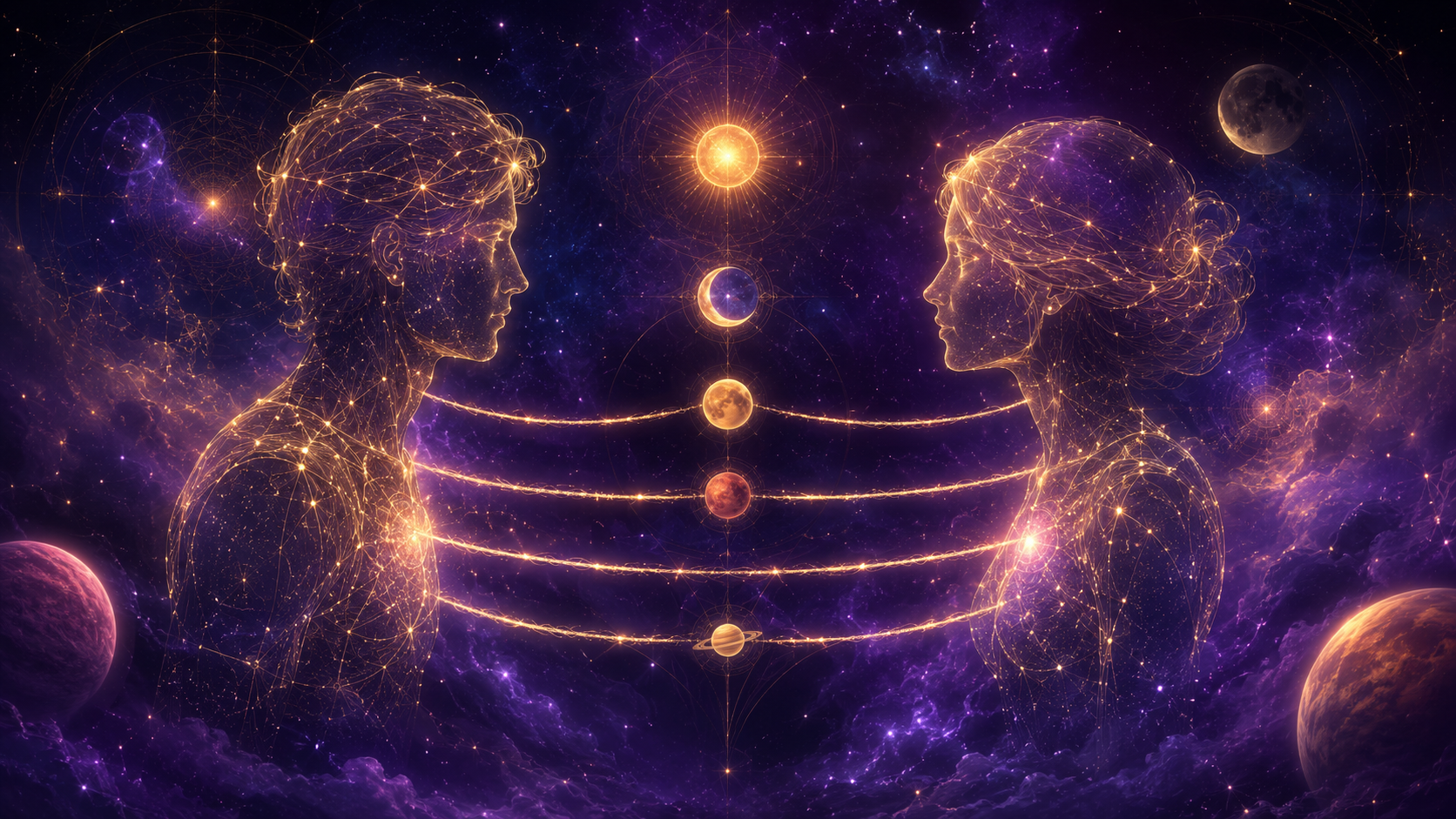
Here is the honest truth most astrologers wish more people knew: comparing two Sun signs tells you almost nothing about a real relationship. It's the layer everyone checks — "I'm a Leo, they're a Scorpio, are we doomed?" — and it's the least useful one. Two people with textbook-"incompatible" Sun signs can build a beautifully harmonious life if their Moon, Venus, and Mars connections align. And plenty of "perfect" Sun-sign pairings quietly fizzle.
Genuine astrological compatibility — what a professional actually looks at — is layered. This guide walks you through the five layers that matter, in the order that matters, so you can read a relationship the way an astrologer does: not as a yes/no verdict, but as a map of where you flow and where you'll grow.
Why Sun-sign compatibility falls short
Your Sun sign is one factor out of roughly ten that a birth chart tracks for each person. Reducing two whole human beings to one of twelve labels each is like judging a book by the first letter of its title. It can be broadly true — a fiery sign and a watery one do approach life differently — but it misses the emotional, romantic, and sexual layers where relationships are actually won or lost. Worse, it produces false verdicts: it declares soulmates "incompatible" and mismatches "perfect," and people believe it.
A "difficult" Sun-sign match is often the most growth-oriented and passionate relationship of your life. Compatibility isn't about avoiding friction — it's about knowing where the friction is, and whether it's the kind that builds something.
The five layers of real compatibility
Here is the framework, from the surface inward. Each layer answers a different question about the relationship — and you need your actual birth details (date, time, and place) to know where each of your planets falls.
Do your fundamental natures and life goals mesh?
Your Sun sign is your ego, your vitality, the core of who you are — and it's the layer everyone already knows. It matters, but it's the opening chapter, not the whole book. Two people with 'incompatible' Sun signs can be deeply happy; two with 'perfect' Sun signs can bore each other to tears. Sun-sign matching tells you the broad temperament fit and little else.
Do you feel safe, understood, and nurtured by each other?
This is the layer most couples actually live in — and the one Sun-sign horoscopes ignore. Your Moon sign is your emotional nature: what you need to feel secure, how you process feelings, what 'home' feels like inside you. When two Moons are in harmony, you just get each other emotionally. When they clash, you can love someone and still feel chronically unmet. If you check one thing beyond your Sun, check this.
Moon sign emotional compatibility →Do you express and receive love in compatible ways?
Venus is your love language written in the sky — how you show affection, what you find beautiful, what makes you feel cherished. Two people can adore each other and still feel unloved because their Venus signs speak different dialects: one needs words, the other needs touch, a third needs acts of devotion. Venus compatibility is why chemistry either deepens into intimacy or quietly fizzles.
Your Venus sign is your love language →Is there real physical spark — and do you fight well or badly?
Mars is desire, drive, and how you pursue what you want — including in bed and in an argument. The classic chemistry signature astrologers look for is one person's Venus in aspect to the other's Mars: attraction meeting drive. Mars also governs conflict style, so it quietly decides whether your disagreements are electric and productive or exhausting and destructive.
Do you click on sight and move through life at the same pace?
Your Rising sign is the 'you' the world meets first — your vibe, your instinctive approach to life. It's a huge part of initial attraction (why you're drawn across a room) and of everyday rhythm once you're together. Compatible Risings feel easy from minute one; clashing ones can create a subtle, persistent 'off-beat' feeling even when everything else fits.
Synastry: how the two charts actually talk to each other
The five layers describe each person. Synastry is where it gets real: it studies the aspects — the angles — between your planets and your partner's. This is the actual machinery of chemistry and friction.
- Harmonious aspects (trines & sextiles) — where things flow. Your planets support each other; these are the effortless, easy-feeling parts of the bond.
- Dynamic aspects (squares & oppositions) — where the tension and growth live. These create friction, but also the charge, challenge, and passion that keep a relationship alive. A chart with only easy aspects can feel flat.
- The chemistry signature — one person's Venus in aspect to the other's Mars is the classic marker of physical attraction and spark.
- The emotional bond — Moon-to-Moon and Moon-to-Venus aspects reveal how deeply you understand and comfort each other.
This is why two people can have "clashing" Sun signs and still feel like home to each other: their synastry is full of supportive Moon and Venus aspects that the Sun-sign label can't see. We break down each synastry aspect in detail here →
Western vs. Vedic: two lenses on the same couple
There are two major systems for reading compatibility, and they're complementary, not competing. Western synastry (the layers and aspects above) is psychological and dynamic — it maps how two personalities interact. Vedic astrology uses a point-based system called Guna Milan (the "36 points" used in traditional matchmaking) that weighs emotional, physical, and karmic compatibility more formulaically. When both systems agree a match is strong, that's the most confident signal you can get. Compare the two systems in depth →
How to actually check your compatibility (the practical steps)
- Gather both birth details. Date, exact time, and city of birth — for both of you. Time matters most for the Moon and Rising sign; without it, those layers are approximate.
- Start with the Moon and Venus, not the Sun. These two layers predict day-to-day happiness far better than Sun signs. Emotional safety (Moon) and feeling loved (Venus) are what relationships live on.
- Read the aspects, not just the signs. A supportive Venus–Mars or Moon–Moon aspect can carry a relationship; a stack of squares tells you where the work is.
- Weigh both systems. If Western synastry and Vedic Guna Milan both point the same way, trust it. Where they diverge, read why.
- Treat it as a map, not a verdict. Astrology shows you the terrain — the smooth roads and the mountains. It never tells you whether to make the journey. That's always yours.
A note on honesty: no chart guarantees a relationship, and no "bad" match dooms one. Astrology is a tool for understanding — for naming what you're each bringing and where you'll flow or stretch. Two committed people can make almost any chart work; the chart just tells you where to bring the attention.
Frequently asked questions
Is zodiac compatibility just about Sun signs?
No — and this is the biggest misconception in astrology. Sun-sign compatibility is only the surface layer. Real compatibility is read across the Moon (emotional), Venus (love), Mars (chemistry), and Rising (attraction) signs, plus the synastry aspects between two charts. Two "incompatible" Sun signs can be deeply compatible underneath.
Which signs matter most for compatibility?
After the Sun, the Moon and Venus are the most important. The Moon governs emotional compatibility — whether you feel safe and understood — and Venus governs how you give and receive love. These two predict everyday relationship happiness far better than Sun signs do.
Can two incompatible signs make it work?
Absolutely. "Incompatible" usually refers only to Sun signs. Challenging Sun-sign pairings often produce the most passionate, growth-oriented relationships, and harmonious Moon, Venus, and Mars connections can more than make up for a Sun-sign mismatch. Compatibility is about understanding the dynamic, not avoiding it.
Do I need my birth time to check compatibility?
For the most accurate reading, yes — your birth time determines your Rising sign and the precise Moon position, which are key layers. Without it, you can still compare Sun, Venus, and Mars signs and get a strong partial picture; the Moon and Rising just become approximate.
Go deeper on each layer
Popular sign-pair compatibility guides
Get your sign’s forecast every month — free
A short, personalized monthly reading and the key dates to watch. No spam, unsubscribe anytime.