
Whole-Sign vs Placidus Houses: Whole-Sign Gives Each House One Full Sign, Placidus Needs Your Exact Birth Minute. Why We Use Whole-Sign
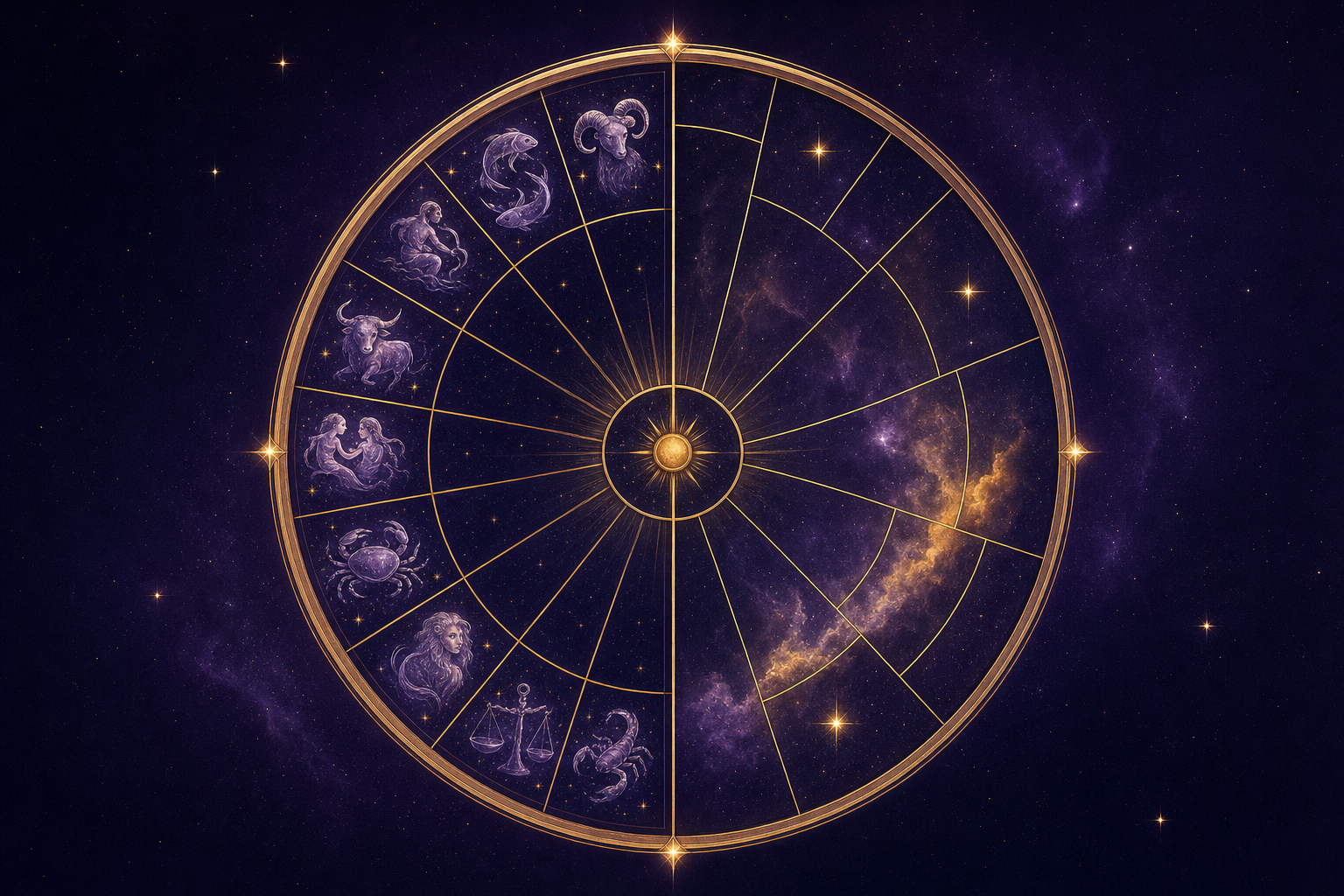
Whole-sign houses give each house one entire zodiac sign. Your rising sign is the 1st house, the next sign is the 2nd, and so on around the wheel. Placidus divides the sky by time: it splits the hours each degree takes to rise and culminate, so the houses come out uneven and the borders, called cusps, fall partway through signs. Placidus needs your birth time to the minute. Whole-sign only needs your rising sign, and when you don't know that, your Sun sign works as a stand-in.
Most of the time the two systems agree. They disagree about planets that sit late or early in a sign, and that is where a reading can change.
Short answer: we use whole-sign for every per-sign reading and every blog post. It's the oldest house system on record, it's what Vedic astrology uses, and it works without a birth time. When you do give a birth time, some of our natal calculations also compute Placidus. Details are further down.
How whole-sign houses work
Take your rising sign (or your Sun sign) as the 1st house and count forward one sign per house. That's the whole method. A Scorpio rising has Sagittarius as the 2nd house, Capricorn as the 3rd, and Leo as the 10th. Every house is exactly 30°, and a planet's house is set by its sign alone: any planet in Leo is in that chart's 10th house, at 1° or at 29°.
This is the house system of Hellenistic astrology, the earliest tradition with houses we have texts for, and it's still standard in Indian (Jyotish) astrology. The Ascendant's exact degree still matters as a sensitive point. It just doesn't draw the house lines. The Midheaven (MC) is treated the same way: it usually lands in the 9th, 10th or 11th house, not always on the 10th.
How Placidus works
Placidus is named after Placidus de Titis, a 17th-century Italian monk and mathematician. It's a quadrant system: the Ascendant is always the start of the 1st house and the MC is always the start of the 10th. The four arcs between the angles are each cut into three houses by dividing time, the hours a degree takes to travel from rising to culminating, rather than dividing space evenly.
Three consequences follow:
- Houses are different sizes. One can span 20°, another 40°. Farther from the equator the difference grows, and a sign can end up with no cusp at all (an "intercepted" sign) while another sign holds two.
- It needs an accurate birth time. The Ascendant moves on average about one degree every four minutes, and every Placidus cusp moves with it. A birth time rounded to the half hour can shift a planet across a cusp.
- It fails near the poles. Above the Arctic Circle and below the Antarctic Circle some degrees never rise or set, so Placidus can't be computed for births there. Whole-sign works at any latitude.
Placidus is the default in most Western chart software, which is why it's the first chart most people see. Koch, Porphyry and Equal are other common options. Equal is closest to whole-sign: 30° houses, but measured from the Ascendant's exact degree rather than from 0° of the rising sign.
Where they disagree: a real example from this winter
On November 14, 2026, Jupiter is at 25°42 Leo and Mars at 24°52 Leo. Jupiter turns retrograde at 27°01 Leo on December 13, 2026 and backs up to 17°00 Leo, where it turns direct on April 13, 2027. (Dates and degrees from NASA JPL Horizons.)
Take a Virgo rising. In whole-sign, Leo is the 12th house, so all of Jupiter's retrograde happens in the 12th: one house, one story (rest, retreat, what's hidden).
Now give the same person a Placidus chart where the 12th-house cusp falls at 22° Leo. That cusp is made up to show how it works. Yours depends on your birth minute and latitude. Jupiter at 27°01 Leo is in the 12th. As it retrogrades below 22° it crosses back into the 11th (friends, groups), and at 17°00 Leo on April 13 it turns direct there. Same planet, same months: one reading says "solitude" the whole way, the other says it starts in solitude and ends up about friends and groups.
Mars shows how sign changes work. It enters Virgo on November 26, 2026, turns retrograde at 10°26 Virgo on January 10, 2027, slips back into Leo on February 22, turns direct at 20°56 Leo on April 1, re-enters Virgo on May 15 and moves on to Libra on July 16, 2027. In whole-sign, each of those sign changes is a house change for every chart on the same day. In Placidus, the house changes happen wherever your personal cusps fall, which could be on those dates or weeks away from them.
Neither answer is "wrong". They're different ways of dividing the sky. But you can only check a Placidus reading if you know the birth time. You can check a whole-sign reading with nothing but a sign.
Try it: this winter's Leo and Virgo houses for your sign
Jupiter is retrograde in Leo from December 13 to April 13. Mars stations retrograde in Virgo on January 10 and finishes its retrograde in Leo on April 1. Find your rising sign (or Sun sign) to see which two houses that lands in, whole-sign.
| Rising / Sun sign | Leo is your | Virgo is your | What that means this winter |
|---|---|---|---|
| Aries | 5th | 6th | Jupiter slows down in your 5th, so a creative project or a romance gets reviewed rather than expanded. Mars stalls in your 6th of work and routine from January 10, so keep the January calendar lighter than you think you need. |
| Taurus | 4th | 5th | Jupiter turns back in your 4th: a move or renovation planned for winter wants a second look. Mars retrograde in your 5th cools a flirtation or a hobby that ran hot in December. |
| Gemini | 3rd | 4th | Jupiter retrograde in your 3rd brings old courses, half-written pieces and sibling conversations back up. Mars retrograde in your 4th puts friction at home. Fix the thing that keeps breaking, don’t start a remodel. |
| Cancer | 2nd | 3rd | Jupiter retrograde in your 2nd says audit the income and the spending before you commit to a bigger number. Mars retrograde in your 3rd makes words sharper than you mean. Draft the email, send it tomorrow. |
| Leo | 1st | 2nd | Jupiter retrograde in your 1st checks how you present yourself and what you promise people. Mars stations retrograde in your 2nd on January 10 and tests impulse spending, so hold big purchases until after April 1. |
| Virgo | 12th | 1st | Mars stations retrograde in your 1st on January 10, so energy and patience run lower than usual. Jupiter retrograde in your 12th says rest is the productive move. Plan on less in Q1. |
| Libra | 11th | 12th | Jupiter retrograde in your 11th shows which group or friendship you’ve outgrown. Mars retrograde in your 12th surfaces frustration you’ve been keeping quiet. Say it to one person, privately. |
| Scorpio | 10th | 11th | Jupiter retrograde in your 10th: a promotion or career move gets reviewed, not refused. Mars retrograde in your 11th stirs conflict inside a team or community. Don’t pick the fight in a group chat. |
| Sagittarius | 9th | 10th | Jupiter, your ruler, turns back in your 9th, so travel, study or publishing plans get a revision pass. Mars retrograde in your 10th slows a work push. Expect delays at the top, not a dead end. |
| Capricorn | 8th | 9th | Jupiter retrograde in your 8th says review loans, joint accounts and anything you owe or are owed. Mars retrograde in your 9th makes a trip or a certification drag. Leave room in the dates. |
| Aquarius | 7th | 8th | Jupiter retrograde in your 7th asks a partner, romantic or business, to renegotiate. Mars retrograde in your 8th heats up shared money and trust. Settle the split before you sign anything joint. |
| Pisces | 6th | 7th | Jupiter retrograde in your 6th shows which daily habits actually help. Mars retrograde in your 7th puts friction with a partner or client front and centre. Keep it about the issue, not the person. |
The full picture of each retrograde is in Jupiter retrograde in Leo and Mars retrograde in Virgo.
Why we use whole-sign, and where we don't
- It works with the information people have. Plenty of people don't know their birth time, or only know it roughly. A whole-sign reading from your Sun sign is coarser than one from your rising sign, but it's the same method and it doesn't pretend to precision it lacks.
- Anyone can check it. Every per-sign line we publish names a real transit and the house it falls in. With whole-sign you can verify that by counting signs on your fingers.
- It matches both of our systems. Vedic astrology counts houses by whole sign, so using it on the Western side too keeps the two readings comparable.
Where we don't: when you enter a birth time in our date and transit calculators, the natal chart is cast with Placidus cusps on the Western side and whole-sign houses from the sidereal Ascendant on the Vedic side. The Mercury retrograde tool, for example, uses the Placidus cusps to say which house your natal Mercury sits in. Without a birth time, no house is calculated at all. We'd rather tell you that than leave you assuming one system runs through everything.
Houses also run underneath other techniques on the blog. A Saturn return is read through the house Saturn occupies, a composite chart has houses of its own, and Vedic and Western synastry both lay one person's planets in the other person's houses.
What a house system can't settle
- There's no test that proves one system right. Astrologers choose by tradition, by technique, and by which one reads true for them. Anyone claiming one has been proven is overstating it.
- A Sun-sign reading isn't your full chart. Counting from your Sun sign is a real layer, but your rising sign, Moon and the exact degrees refine it, sometimes a lot.
- A wrong birth time beats any house system. If your time is a guess, a Placidus chart looks precise but can put planets in the wrong houses. Whole-sign from a correct rising sign is safer than Placidus from the wrong minute.
- Houses show the area of life, not the outcome. They tell you where a transit lands, not what happens there.
Astrology is a tool for reflection and timing, not fate. A house system is a way of dividing the sky, not a verdict on your life.
Frequently asked questions
What is the difference between whole-sign and Placidus houses?
Whole-sign houses give each house one entire zodiac sign, starting with the rising sign as the 1st house. Placidus divides the sky by time from the Ascendant and Midheaven, producing unequal houses whose borders fall partway through signs. Placidus needs an exact birth time; whole-sign only needs the rising sign.
Which house system is more accurate?
Neither has been shown to be more accurate. They answer the question differently. Whole-sign is the oldest system on record and is standard in Vedic astrology; Placidus is the most common default in modern Western software. If your birth time is uncertain, whole-sign is the more robust choice.
Why do my planets change houses between whole-sign and Placidus?
Because Placidus cusps fall partway through signs. A planet late or early in a sign can sit on the other side of a Placidus cusp from where whole-sign puts it. Planets in the middle of a sign usually land in the same house in both systems.
Can I use whole-sign houses without a birth time?
Yes, by using your Sun sign as the 1st house. It's a coarser reading than one from your rising sign, but it uses the same method. That's how per-sign horoscopes and our season readings work.
Does Consciera use whole-sign or Placidus?
Whole-sign for all per-sign readings and blog posts. When you give a birth time, our natal calculations compute Placidus cusps for the Western chart and whole-sign houses from the sidereal Ascendant for the Vedic chart.
Get your sign’s forecast every month — free
A short, personalized monthly reading and the key dates to watch. No spam, unsubscribe anytime.